 Chloe M.Google review
Order arrived damaged and nobody has replied to my email in three days.

Reopen the original case, skip the troubleshooting script, and put a senior person on it the same day. A second failure of the same fault changes the customer's position in many markets: repair may no longer be the only remedy you can offer, and refund or replacement can come into play. Tell the customer what happens next and when, and stop asking them to explain it again.
The principle that holds in most markets: a seller or warrantor gets a fair chance to fix a fault, and that chance is limited. Once repair has failed, or has taken too long, the customer can usually move to a bigger remedy. What counts as enough attempts varies. So does whether the claim goes against the seller or the manufacturer. Check your own market. This is general information, not legal advice.
| Market | When repair stops being enough | Worth knowing |
|---|---|---|
| US | A full warranty must offer a refund or replacement if the product can't be repaired after a reasonable number of tries. | Many products carry a limited warranty instead, so read the terms. State law may add more. |
| UK | The final right to reject applies after one repair or one replacement if goods still don't conform. | No deduction for use in the first 6 months, with exceptions for motor vehicles and specified goods. Faults in the first 6 months are presumed to have been there at delivery. |
| EU | Repair or replacement must happen within a reasonable time, or a full or partial refund may apply. | Legal guarantee is at least 2 years. For goods bought from 31 July 2026, choosing repair adds a year to it, once, and national law can go further. |
| Australia | Several repair attempts may indicate the fault could not be fixed in a reasonable time, which gives the customer major failure remedies. | A major failure lets the customer choose a refund or replacement, with no deduction for use. |
| India | Sellers and inventory platforms cannot refuse return or refund of defective goods bought online (rules 6(3) and 7(4)). | Grievance officers acknowledge within 48 hours and resolve within one month. An amendment effective 1 January 2027 adds a copy of the recorded complaint. |
| Canada (Quebec) | Repairs to appliances and devices covered by the law carry a 3-month warranty. If the same problem returns in that period, the repairer fixes it free. | A merchant may not require the customer to deal with the manufacturer. Other provinces differ. |
| Singapore | If repair or replacement isn't achieved properly, the customer can seek a reduction or rescind the contract. | Repair must happen within a reasonable time and without significant inconvenience. |
| UAE | Failure to repair or replace a defective product free of charge is punishable. | Applies to suppliers across the UAE mainland and free zones and to UAE-registered ecommerce platforms. It does not apply to ecommerce between UAE customers and businesses registered outside the UAE. |
The Australian regulators' guide has a case worth reading. A coffee machine bought for A$1,800 was repaired several times, then replaced, and the replacement broke down three times; the customer successfully sought a refund. The same guide says it may be cheaper to replace a faulty product than to pay for repeated repairs. A repair is only a saving if it holds.
Two changes to watch. In the EU, the repair directive applied from 31 July 2026. In Australia, a December 2025 Treasury decision statement records ministers' agreement to add civil penalties and stronger enforcement to the consumer guarantees, with draft laws still to come. The ACCC said in April 2026 that reports about consumer guarantees rose 20% in 2025 to over 38,000, that improving compliance with consumer guarantees, with a focus on consumer electronics, is a 2025/26 enforcement priority, and that compliance with consumer guarantees will continue to be a priority for 2026/27.
This decides nearly everything, so settle it early.
Don't let the warranty end date decide this. A repaired product that fails again just after the warranty ended may still be covered by statutory rights in several markets. The ACCC says businesses may owe a remedy after a warranty has expired.
| Situation | Owner | First move | Never |
|---|---|---|---|
| Same fault within weeks of repair | Senior service manager | Reopen the case and call the customer | Open a new ticket and restart the script |
| Same fault, unit is essential (fridge, only washing machine) | Senior service manager | Priority visit or a loan or interim option | Quote the normal queue time |
| Third repair on the same unit | Senior service manager, warranty lead | Review for refund or replacement before booking a visit | Book a fourth repair by default |
| Unit unsafe (burning smell, shock, gas) | Safety lead | Tell them to stop using and isolate it, follow safety process | Ask them to test it again |
| Technician says the fault is new | Senior service manager | Share the report in plain language | Tell them it's different without evidence |
| Technician says misuse | Senior service manager | Share evidence, offer a route to dispute it | Refuse flatly with no explanation |
| Out of warranty, recent repair | Warranty lead | Check repair warranty and statutory rights | Quote for a paid repair of a failed repair |
| Customer asks for refund | Senior service manager | Check the market rule and the repair history | Say we only repair, it's policy |
| Public post | Social owner | Acknowledge the repeat, move private | Reply with a generic troubleshooting link |
First reply
Hi [name], I can see we repaired your [product] on [date] for [fault], and now it's failed again. You don't need to repeat anything. [Name], our senior service manager, has your case and will call you by [time] today to agree what happens next, including whether another repair is even the right answer.
Public reply
That's not good enough, [name], sorry, especially after the repair. Your case is with a senior manager now. We've messaged you directly so we can sort it without your details going on here.
Update when there is no news
Hi [name], the part for your [product] is due at the depot on [date] and we've got no earlier date. I don't want you waiting without a plan, so [name] will call you by [day] to discuss a loan unit or a replacement.
Closing reply
Your replacement [product] arrives on [date] and we'll take the old one away the same visit. I've noted this on your record, so if anything goes wrong you'll come straight to me and won't start from scratch.
Hard case: the technician found misuse
Hi [name], the technician's report says [plain description of cause], so this visit isn't covered by the repair. I know that isn't what you wanted to hear. I've attached the report. If you think it's wrong, reply here and [name] will have a second technician review it at no cost.
Hard case: you can't refund, you can only repair
Hi [name], on what we've seen so far, the next step is one more repair with a different engineer, on [date]. If the fault comes back after that, I'll move this to a refund or replacement review. I've written that on your case so you won't have to argue for it again.
Time targets are suggested starting points only. They are not benchmarks.
It's working when repeats go to a named person within your target, and the worst model or centre on the list starts to improve.
This is an example scenario. The brand, customer, product and messages are made up to show how Relay works. It is not a customer story.
Lan Nguyen messages appliance brand Coolbreeze on WhatsApp in Vietnamese: Máy giặt mới sửa ba tuần trước lại hỏng rồi. Vẫn là lỗi cũ. (The washing machine that was repaired three weeks ago has stopped working again. The same problem again.) An hour later she posts on X, tagging the brand: Coolbreeze service is a joke. Same fault twice in a month.
The WhatsApp message and the X post land on the same customer timeline as the repair case closed three weeks ago. The agent reopens that case instead of opening two new tickets. Relay counts it in the reopen rate and the priority goes up. The case is routed to the senior service manager for the region, who can read the history, so Lan doesn't have to explain twice. The escalation ladder keeps the clock running.
A person approves a short reply on X, in English, that moves the conversation private. A Vietnamese-speaking agent sends the WhatsApp reply:
Chị Lan ơi, chúng tôi rất tiếc vì sự phiền toái này một lần nữa. Khiếu nại của chị đã được chuyển đến quản lý dịch vụ cấp cao của chúng tôi, người sẽ liên hệ với chị. (Lan, we are sorry for this trouble again. Your complaint has been sent to our senior service manager, who will contact you.)
Every reopened case adds to the reopen rate, so the team can see which repairs keep coming back. See also appliance warranty claims and how to do online reputation management.
One queue, tagging, matching a public post to the open case, routing by region, the escalation ladder, SLA clocks, reopen rate reporting, the event log and drafted replies a person approves run in Relay today. Drafts start from a template for the complaint category, so your agent adds the repair history and handles the language. A spike in complaints triggers alerts in-app and to Slack, webhook or email.
These parts are on the way: product and service history lookups from your own service system by serial number, and technician booking for the follow up visit. Until then, the senior manager checks the repair record in your service system and books the visit there. If repeat complaints keep landing in the general queue, contact us.
There's no universal number. In the UK the final right to reject applies after one failed repair or replacement. Elsewhere it may be a reasonable number of tries or a reasonable time, so set your internal review trigger low and check your market.
It depends on the warranty terms and on local law. In the EU, for goods bought from 31 July 2026, choosing repair adds a year to the legal guarantee, once. Quebec gives a 3-month warranty on covered repairs.
In Australia the seller must not tell customers to go to the manufacturer for a remedy, though the manufacturer may have to reimburse the seller. Quebec has a similar rule. Elsewhere, check who owes the remedy before you redirect anyone.
Sometimes. The UK allows a deduction after the first 6 months with exceptions, while Australia requires a full refund with no deduction on a major failure. Check your own market first.
Most laws don't define this, so write your own working definition and apply it consistently. A sensible rule is same symptom or same part, confirmed by the technician. When unsure, treat it as a repeat for handling purposes.
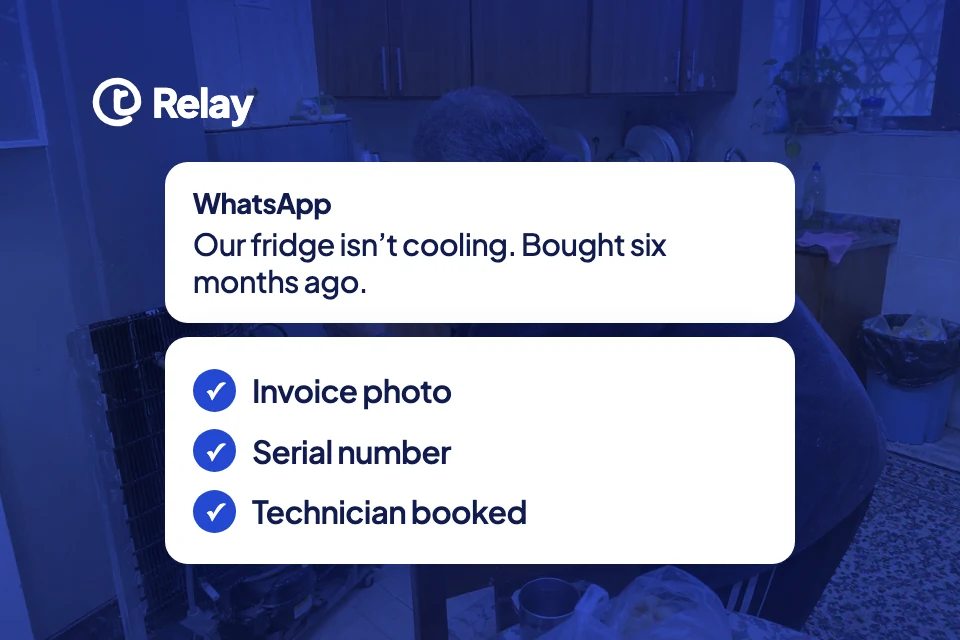 AppliancesHow to handle appliance warranty claims on WhatsAppStatutory rights versus your warranty by market, what proof you can ask for, a triage table and WhatsApp replies you can paste.7 November 2026 · 12 min read
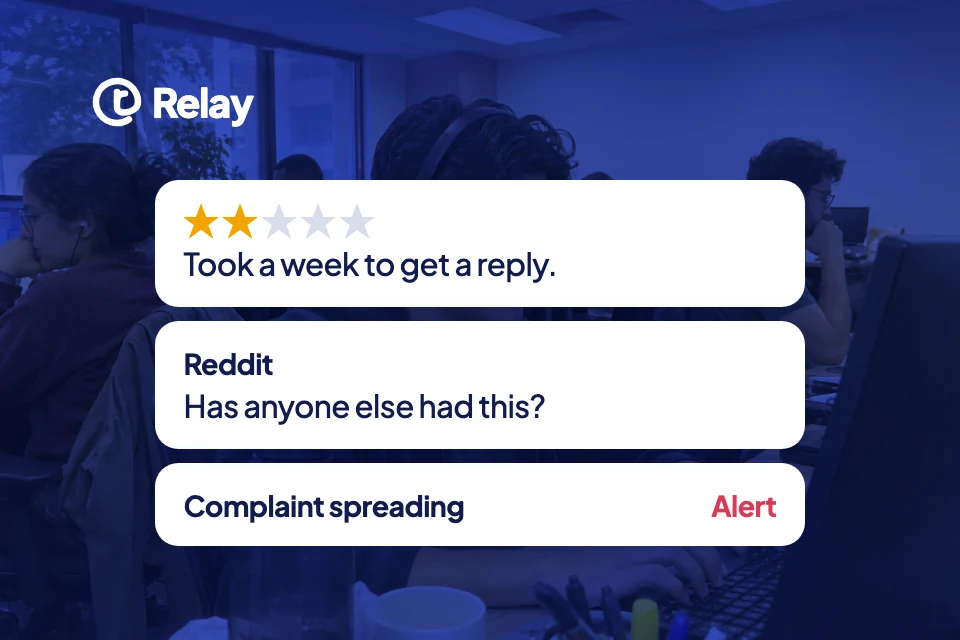 GuidesIntroducing Relay: your online reputation in one placeWhat Relay is, the gap it was built for, what it does today, what it does not do yet, and who should choose something else.29 October 2026 · 6 min read
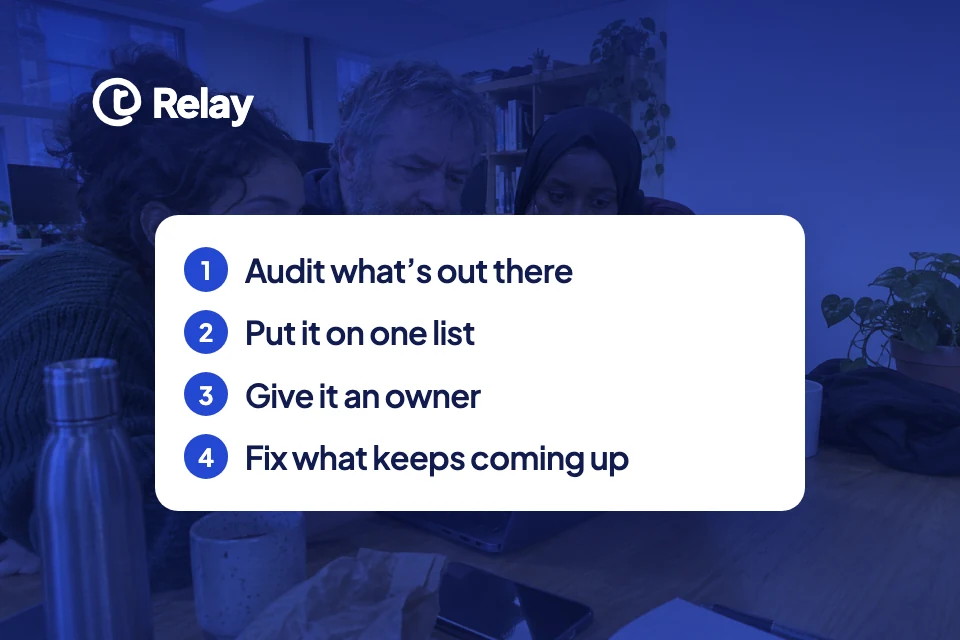 GuidesHow to do online reputation management, step by stepFind what people say about your business, answer it within the rules, fix what caused it. A plan, a triage table and replies you can copy.9 November 2026 · 11 min read
Get a personalised 30 minute demo on your own channels and policies. We show you Relay handling your real conversations, then set it up with you.
Brands we work with