 Chloe M.Google review
Order arrived damaged and nobody has replied to my email in three days.
What happens to a complaint in Relay, step by step, including where it stops and a person takes over and what is not built yet.
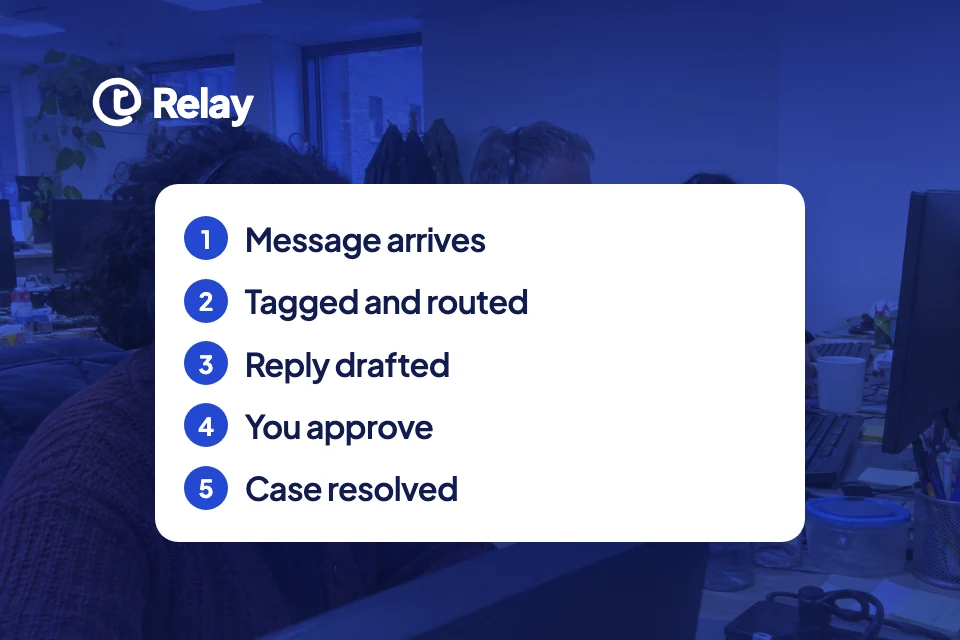
Relay is a support desk that puts customer messages and public posts in one queue, labels each one, sends it to an owner with a clock, and starts a draft reply for that person to edit and send. Nothing leaves Relay until a person presses send. This post follows one complaint through the system, then lists what doesn't exist yet, so you can decide if it fits.
This example is made up. Yuki Tanaka writes a two-star Google review of an imaginary courier: "Parcel is five days late, tracking hasn't moved, and nobody answers."
Two services do the work. A listening engine collects posts and reviews, and the Relay app holds the queue, the tickets and the reports.
| Source | How it gets in | Needs |
|---|---|---|
| Reddit, YouTube, Hacker News, Bluesky, Google News, Quora through search | Polled on a timer | Some need an API key |
| Apple App Store, Google Play | Polled from public store pages | No key for reviews |
| X | Polled, or real-time stream | X API key |
| Google Business Profile reviews | Polled every 10 minutes by default | Access token per account |
| Instagram, Facebook, WhatsApp | Webhooks | Meta tokens |
| Telegram | Webhook | Bot token |
| Forwarding address, or Gmail and Outlook | Access token for Gmail and Outlook | |
| Anything else | REST ingest endpoint | API key, once set |
Yuki's review arrives on the Google Business poll. It is stored against the workspace and de-duplicated.
Each message gets sentiment, a graded intensity, a sarcasm check, a category, a priority and a route. In the live pipeline this is a set of rules in code, so it behaves the same way every time, and it keeps working if an AI service is down. It reads English. An AI model classifies messages only on the triage screen, where someone pastes one in. If an AI key is set, the Insights narrative also sends short sample quotes from emerging topics to a model.
Yuki's review reads negative, category late delivery, and the route is draft then approve. Sarcasm matters here too: "Thanks for the fast delivery, it never arrived" is read as a complaint, so it isn't answered as praise. Star ratings aren't passed to the live classifier, so a polite review with a low star is judged on its words alone.
A ticket is created with an SLA policy based on its category and priority. The clock shows time remaining, flags a warning, and records a breach. Warnings and breaches can raise alerts. Reach and reply counts can raise priority, so a complaint from a large account or one gathering replies moves up.
Money and safety topics have fixed routes. Refund, payment and perishable-damage cases go to a person, and so do messages asking for a person or where the classifier falls below its confidence floor. Categories, SLA times, escalation tiers and thresholds are edited in Settings without a new release. Car brands get extra routing by dealer and an escalation ladder; other workspaces don't.
An agent opens the ticket and sees a draft. Today that draft is a starting point: a template chosen by category. Treat it like a note from a new starter, and check every promise in it against your policy before sending. The agent edits it and presses send.
The reply goes out through the channel's own API, in this case Google's review reply endpoint. Google then checks it, which usually takes up to 10 minutes and sometimes up to 30 days.
If the channel has no token connected, Relay says so. The result is labelled simulated in the log and under the sent message, so nobody believes a reply went out when it didn't. Channels that can't do something, such as LinkedIn private messages or replying on Quora, return unsupported and that is logged too.
Every ticket keeps an event log: created, first response, status changes, assignment, reopens, sentiment changes, notes. First response time comes from the moment a send succeeded. A simulated send on an unconnected channel also stamps it, so connect the channel before you trust this number. If the case is reopened after being resolved, that is logged and counts toward reopen rate.
Mentions are grouped into themes by keyword rules you set, and counted in 15-minute windows. Relay learns what is normal for each theme and scores it on six signals: deviation from its own baseline, velocity, concentration, sentiment intensity, amplification and spread across platforms. Every score shows how much each signal added, and why an alert did or didn't fire.
Alerts fire when a theme changes level, and go to the recipients for that level. A theme has to hold above the crisis threshold for a set number of windows, two by default, before it is declared a crisis. One hot window can still move a theme to watch or elevated and alert those recipients. A new theme needs four windows of history before volume signals count. While any theme is at elevated or crisis level, Relay tells the engine to poll three times as often, with a floor of 20 seconds.
Delivery is in-app always, Slack by webhook, any other system by webhook (signed once a signing secret is set), and email when an email key is set. A single bad review doesn't page anyone. It takes a pattern. Alerts aren't sent by WhatsApp today.
An executive watchlist flags posts naming specific people, with its own recipients. A separate step clusters recent text to surface topics nobody has defined as a theme yet.
Reports compute first response time, turnaround, SLA attainment, sentiment turnaround and reopen rate from the ticket records, plus share of voice against rivals from the listening engine. A reopen counts when a resolved ticket comes back within 48 hours. Under 20 tickets the reporting screen shows labelled sample data in place of your numbers. There is CSV export, print and scheduled reports. Sending those by email needs a key. With 20 or more tickets CSAT shows as n/a, because there is no survey in Relay. The sample data shown below 20 tickets includes a sample CSAT figure.
| Situation | Who decides |
|---|---|
| Every outbound reply | A person presses send |
| Refunds and payments | A person, routed by rule |
| Requests to speak to a person | A person, routed by rule |
| Anything the classifier is unsure about | A person, below the confidence floor |
| Merging two customer identities | A person confirms suggested matches, on car brand workspaces only |
| Standing up a crisis | Alerts inform a person. Relay doesn't post on its own |
We built it this way on purpose. A British Columbia tribunal held Air Canada responsible for what its chatbot told a customer, and customers mostly want a route to a person. For the general playbook, read how to automate customer support.
We would rather you heard this now than after buying.
Relay is two Node services, and they need no third-party database, so they can run on a server you control. Data sits in files on that server. It needs a host with a lasting disk, because a serverless platform will discard the files. A managed database isn't built yet. Write endpoints in the Relay app are protected by an API key once one is set.
It fits a team that has public complaints going unanswered, wants them in the same queue as email, and wants a person on every reply. It doesn't fit a team that needs a chatbot to deflect volume today, or a full helpdesk with web chat, a help centre and order actions. Use a dedicated helpdesk for that.
If you want to go through your own channels with us, contact us. The introduction covers why we built it.
No. Every outbound reply needs a person to press send. Automatic sending isn't built, and the autonomy controls on screen don't change that.
Not today. Live drafts come from templates chosen by category, so a person has to check them against your policy. Connecting policy documents to drafting is not done.
Relay marks the send as simulated, in the log and under the message. It never reports a delivery that didn't happen. Each channel lists what it can and can't do.
It scores each theme against that theme's own history, on six signals, and a theme has to hold above the crisis threshold for two windows by default before it is declared a crisis. A busy day lifts everything a little, while a real problem lifts one theme a lot. Every alert shows the reason it fired.
The live pipeline reads English today. There is no language detection. If you need other languages, talk to us before planning around it.
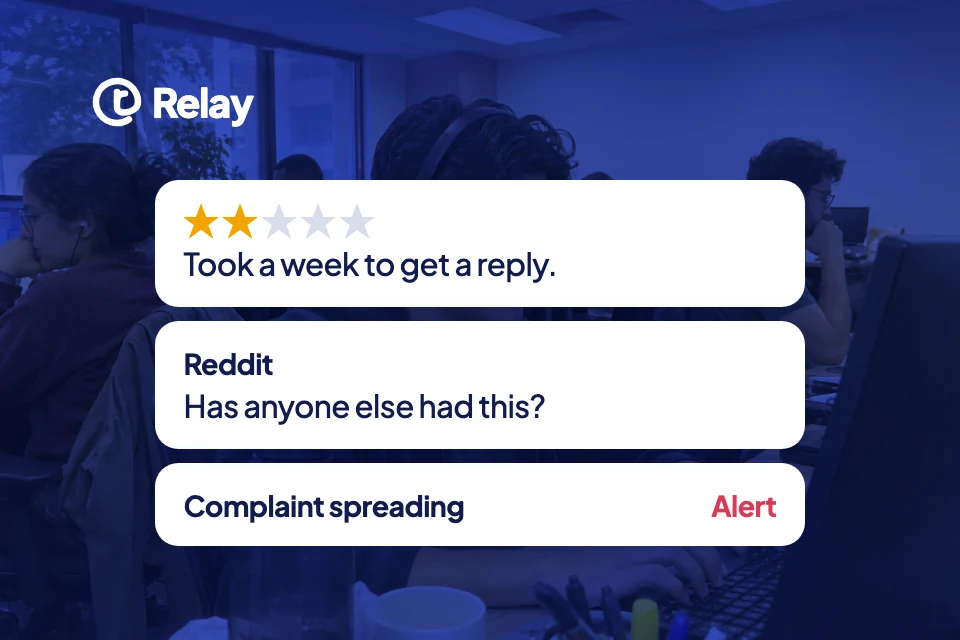 GuidesIntroducing Relay: your online reputation in one placeWhat Relay is, the gap it was built for, what it does today, what it does not do yet, and who should choose something else.29 October 2026 · 6 min read
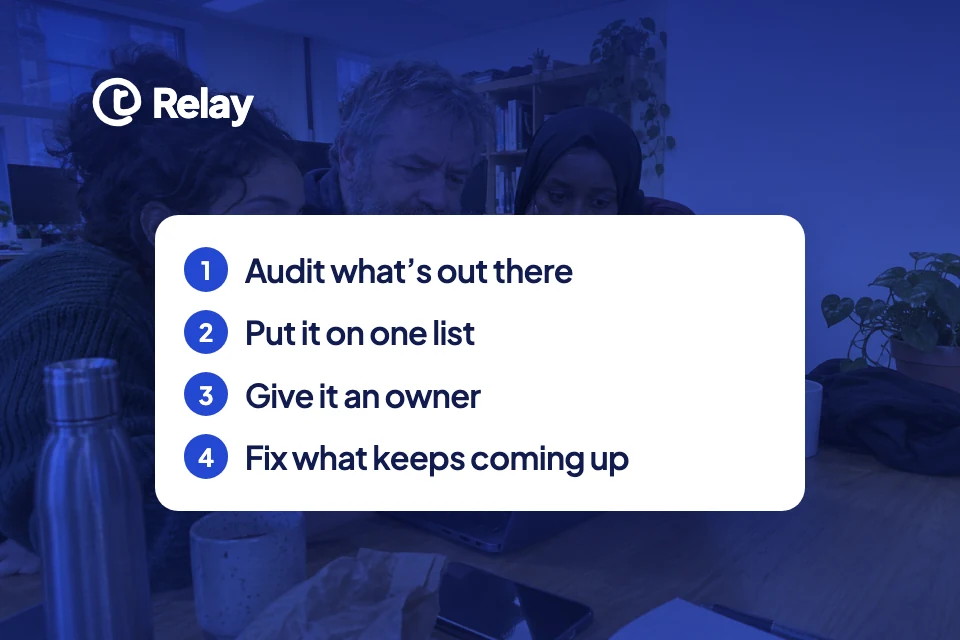 GuidesHow to do online reputation management, step by stepFind what people say about your business, answer it within the rules, fix what caused it. A plan, a triage table and replies you can copy.9 November 2026 · 11 min read
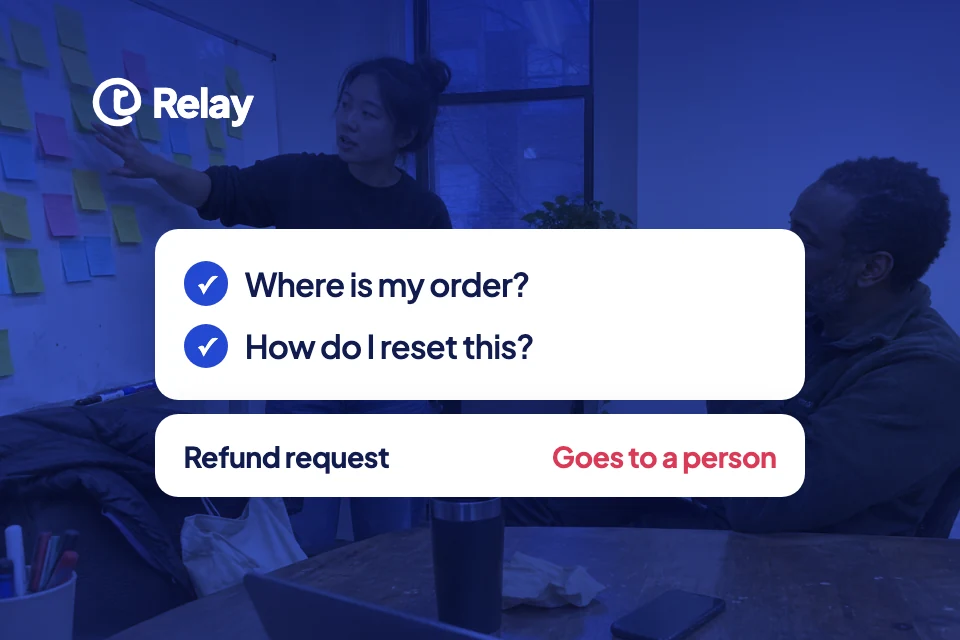 GuidesHow to automate customer support without trapping your customersWhat to automate, what to keep with a person, what the law says about AI disclosure, and how to tell whether automation is really working.9 November 2026 · 12 min read
Get a personalised 30 minute demo on your own channels and policies. We show you Relay handling your real conversations, then set it up with you.
Brands we work with